
SWEMF Workshop for voices with Emma Hornby.
14th February 2026 – St Monica’s Chapel, Cote Lane, Bristol.
A group of about seventeen participants assembled in the Chapel at St Monica Trust, Cote Lane, Bristol, for Professor Emma Hornby’s vocal workshop on Quinquagesima Plainchant. Professor Hornby is a world expert on this kind of music and was an extremely engaging tutor. Some of the participants were very experienced in singing this kind of music, and singing it from neumes rather than modern conventional notation, but for others it was a first.
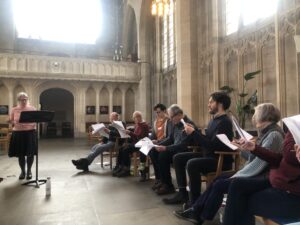 We had two booklets of music. In the first, there were seasonal Hispanic chants, and we began with the Lamentations of Jeremiah from the thirteenth century Spanish Silensian Codex. Prof. Hornby explained that the earliest manuscripts which we can now decipher showed the ‘ebb and flow’ of the music rather than precise rhythms, and this chant was an example. We then moved on to a setting of verses from Psalm 99, ‘Jubilate Domino omnis terra’ which is a more complex and precisely notated chant, used for the Sundays leading up to Ash Wednesday, of which Quinquagesima is the first.
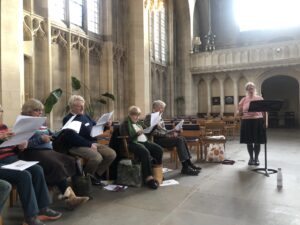 We then moved on to a very early piece of polyphony (thirteenth century), based on the chant ‘Posuisti Domine’. This was a slow-moving expression of the chant, over which an elaborate upper part floated. It took us a while to get the hang of fitting the two parts together as they were so contrasting in speed and complication, but once we had worked out the points at which the two parts were in unison, we were able to re-group and carry on.
Having worked hard all morning on these pieces, we had an unusual lunch break, because the string players of the Royal Welsh College of Music had come to give a concert for the St Monica’s residents and visitors, so we were able to listen to some Bach and Schoenberg as well as eating our sandwiches.
After lunch, we turned our attention to some of the music in the second booklet, ‘Sunday Vespers throughout the Year’, from the Benedictines of Solesmes, a leading centre for Gregorian chant with a history stretching back 1000 years. We sang the hymn ‘Lucis Creator Optime’, the Magnificat Antiphon and Tone together with the Magnificat itself, and finally the ‘Ave Regina Caelorum’. This music was all Gregorian chant, and we sang it from neumes. Under Professor Hornby’s encouraging and stimulating leadership, we learned a great deal about the background to the music we were singing, how it had been preserved, and its liturgical context.
Our confidence greatly increased during the day, and by the time we reached the conclusion of the workshop we felt reasonably prepared to ‘perform’ it to an audience in the chapel. The audience started off with only two people but as others passing the chapel heard the sound of singing floating out, they came in to join the listeners, and by the end there was very warm and appreciative applause from an audience in double figures.
The participants warmly thanked both the organisers of the workshop (Jonathan and Jenny Tribe) and Professor Hornby for a most enlightening and informative day, in surroundings perfectly suited to the liturgical music we studied.
Jane Warren