
SWEMF Workshop for voices and instruments with Ben England.
7th March 2026 – West Leigh Infants’ School, Backwell.
Ann Heymans organised this workshop which took place on 7th March at West Leigh Infants School in Backwell, near Bristol. This school was built in 1969, typically flat-roofed and not designed with the performance of early music in mind! However, there is parking and level access, and a warm welcome from the friendly and helpful School Business Manager. We were based in the large and high-ceilinged hall which easily accommodated the seven instrumentalists and about thirty singers, some arriving by train.
The day was led by Ben England on a return visit to Backwell. Ben grew up in Essex and was a church chorister. He studied at Bristol University and now lives in Bristol with his family. He was recently the conductor of Nailsea Orchestra, now known as North Somerset Philharmonia. He has become renowned through his pioneering work with online music-making, which blossomed during the period of social distancing when Home Choir and Choir of the Earth were formed. In addition Ben now organises Come and Sing events in other countries, with a Bach based trip to Leipzig from 26th – 30th October this year, including a performance at Nikolaikirche.
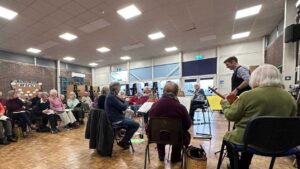 The musical extracts from Dido were selected by Ben, with links provided to scores and teaching videos for preparation in advance. Ben tactfully abandoned the “Dance of the Furies” as it threatened to be more “dead” than “Dance” owing to frantic quaver figures for the violins! Apart from that small hiatus (which Ben had envisaged as he didn’t approach it at the beginning of the day) both instrumentalists and singers made a good job of the choruses chosen. Ben knows the story intimately and by the end of the day we had a much better idea of how the action progressed, even if there was nothing like a story thread to follow. Ben was keen to emphasise that this was to be performed as opera, so that the singers needed to imagine themselves on stage and project through the use of facial expression and very clear consonants. He talked about the way Purcell illustrated the text with the use of certain intervals and direction of melody. Ben also spent some time on vocal technique and the singers seemed to relax into a convincing and confident way of expressing the music and story.
Physical response was encouraged, especially in scenes involving witches or sailors. The Witches Chorus in the Second Act was prefaced by some cackling practice which loosened up the old vocal chords and accompanied many whoops and gestures. Ben appropriated the “Come Away Fellow Sailors” aria in Act Three. He morphed himself into an exaggerated Bristolian character, all flashing eye whites, winks and gestures. It really was a masterclass, which seemed to encourage a much less restrained response from the choir who “heaved the capstan round” and “spliced the mainbrace” in their imaginations, whilst dancing a hornpipe and generally having uninhibited fun.
Coda
My husband (a Gilbert and Sullivan fan) turned up unexpectedly (from Horsham!) for the final run-through. These were his comments about Ben’s approach:- “Inspirational, kindly, considerate, encourages the unorthodox, makes sure everyone takes part. Might have been a sailor, should audition for HMS Pinafore, forgot to say what Aeneas did next – he had a rôle in the foundation of Rome!”
Many thanks are due particularly to Ann, and her helpers on the day, for such an enjoyable and successful workshop.
Heather Gibbard